Heading 2
Regulated vs. Deregulated Energy States: The Guide Multi-Location Operators Actually Need
If your business has locations in Texas, Ohio, Pennsylvania, Illinois, New Jersey, Maryland, or D.C., you have a choice that most operators don't know they have:You don't have to pay whatever your utility charges.
Jul 14, 2026
10 min
Index
By Ozge Islegen-Wojdyla, Ph.D., Co-Founder and CTO at TrueMeter
If your business has locations in Texas, Ohio, Pennsylvania, Illinois, New Jersey, Maryland, or D.C., you have a choice that most operators don't know they have:
You don't have to pay whatever your utility charges.
Those states are part of a list of U.S. markets where the retail electricity market is open to competition, plus another set where natural gas is deregulated even when electricity isn't. Competing retail suppliers bid for your business, so you can buy power at a rate that's negotiated, not dictated.
Most multi-location operators have no idea this is an option. And that means most of them are quietly overpaying every single month without realizing it.
This guide is for operators who want to understand how the system actually works, and what to do about it.
What "Deregulation" Actually Means (in Plain English)
In the United States, energy markets can be either regulated or deregulated (or partially regulated). The difference matters a lot for your energy costs.
Regulated states: The utility is both the supplier and the distributor. They generate (or purchase) the power, they run the wires, and they set the price. You pay what they charge.
There's no negotiating, no switching, no alternative. Florida and Georgia (for electric) are examples.
Deregulated states: The utility still handles the physical delivery of energy including the poles, wires, and pipes, but the commodity itself (the actual electricity or gas) can be purchased from competing retail suppliers. You can shop, compare, lock in a rate, and switch.
The utility doesn't go away in a deregulated market. They still deliver your power and handle outages. But they're no longer the only entity allowed to sell it to you.
This distinction creates a real financial opportunity, one that most multi-location operators are sitting on without knowing it. In deregulated states, you don't have to pay whatever your utility charges. Instead, you can shop for a better rate.
Which States Are Competitive?
Deregulation varies by state, and sometimes even by utility territory within a state. The table below covers all 50 states plus D.C., with their current retail market status.
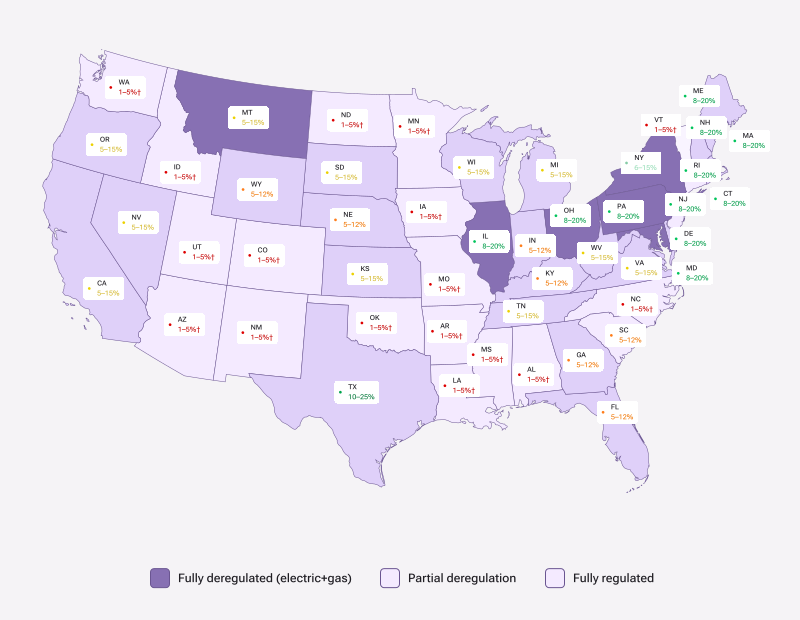
Texas is the gold standard. It has more than 100 retail providers and is the only mandatory-choice market in the country, meaning there is no default utility option and operators have to choose a supplier.
Ohio and Pennsylvania are the strongest secondary markets, with deep pools of licensed suppliers (Ohio through its PUCO-certified providers, Pennsylvania through the PA Power Switch program).
New Jersey and the Chicago metro in Illinois round out the markets that matter most for multi-location operators. Both are large, high-competition markets with deep pools of licensed retail suppliers. That matters because these businesses tend to concentrate in major metros. The more suppliers bidding on your business, the better the outcome of a competitive procurement.
A nuance worth flagging: not every state that passed deregulation legislation followed through with full implementation. Michigan capped competitive supply at 10% of each utility's retail sales, and the program has been fully subscribed since 2009, with more than 5,000 customers on the waitlist. California is another special case. Residential direct access was suspended after the 2001 energy crisis, though C&I customers can participate under a cap, and 25+ Community Choice Aggregation (CCA) programs now serve millions of California customers under different regulatory rules.
In other words, “deregulated” is not always the same as “competitive.” That's exactly why operators need to verify their specific situation, location by location, before assuming they have an opportunity… or that they don't.
How Competitive Procurement Works
If you're in a deregulated state and not already working with a retail energy supplier, here's what the path to savings looks like:
Step 1: Understand your current rate
This sounds simple, but most operators don't actually know what rate plan their locations are on, which supplier (if any) they've contracted with, or when that contract expires. That information is on your bill, but utility bills are notoriously hard to read.
Step 2: Assess your market
Not all deregulated markets offer the same savings opportunity. Texas has the most competitive retail market in the country. New York is deregulated but complex. Your opportunity depends on your locations, your usage profile, and current market conditions.
Step 3: Run a competitive auction
This is the mechanism TrueMeter uses for our clients. We aggregate demand across all of a client's locations in deregulated markets and go to market. Multiple licensed retail suppliers bid for the business. We compare bids against current utility default rates and identify the best option.
Step 4: Lock in a rate
Once a supplier is selected, we execute with your approval a fixed-rate contract. You know exactly what you're paying for the commodity for the duration of the contract, which is typically 12 to 36 months. No surprises.
Step 5: Monitor and re-optimize
Contracts expire. Market conditions shift. New Community Choice Aggregation programs emerge. TrueMeter monitors every contract and market across our client portfolio continuously so you don't have to.
What the Savings Opportunity Looks Like
The honest answer is, it depends on your state, your usage profile, current market conditions, and how long it's been since anyone looked.
In our experience, operators in competitive markets who have been sitting on default utility rates, either because they never knew they had a choice or because a supplier contract quietly expired, typically see 10 to 20% reductions on the commodity portion of their bill when we run a competitive procurement process.
It's worth calling out that the commodity portion isn't your entire bill. There are delivery charges, taxes, and other line items that don't change regardless of supplier. But commodity often represents 40 to 60% of total electric spend, and it's the part you can negotiate.
A Real Example: 15% Reduction Across Multiple Locations
We worked with a multi-location entertainment operator in a deregulated market. They had two locations where we ran a competitive procurement auction, soliciting bids from licensed retail suppliers on their behalf.
The result: a 15% average reduction in energy costs across both locations. No new equipment. No operational changes. No disruption to their business.The operator’s team was not involved in the process. TrueMeter handled the market assessment, the auction, and the contract execution.
The Most Common Reason Operators Miss This
It's a problem of complexity. To take advantage of deregulated markets, you need to know:
- Which of your states are competitive (and for electricity, gas, or both)
- Which locations are on supplier contracts vs. default utility rates
- When each of those contracts expires
- What current market rates look like in each territory
- Who the licensed suppliers are in each ISO/RTO (ERCOT, PJM, ISO-NE, NYISO, MISO, CAISO, SPP)
- What's happening with capacity auctions and BGS pricing events that will reprice your default service
For a 10-location operator, that's manageable, if barely. For a 50-, 100-, or 500-location operator, it's a full-time job at minimum. And the businesses most likely to have multiple locations in deregulated states like multi-unit restaurants, retail chains, hospitality groups and franchisees are exactly the businesses least likely to have internal energy teams dedicated to tracking any of this.
The other issue: energy is the third-largest operating expense for most restaurants and retailers, but it rarely gets the same scrutiny as food costs, rent, or labor. It's treated as a fixed, unavoidable cost. For most operators, no one has ever told them it isn't.
What to Do Right Now
If you have locations in any of the deregulated or partially deregulated states listed above, the first step is simple: find out what rate you're currently paying and whether you have an active supplier contract.
If you don't know the answer to either question (and most operators don't) that's exactly what TrueMeter's free audit surfaces. We pull and analyze your bills, identify which locations are in competitive markets, flag any contracts that have expired or are about to, and give you a clear picture of what your savings opportunity looks like.
No cost. No commitment. No changes to your operations until you decide you want to move forward.
Want to know if your locations are in deregulated markets and what you could be saving? Book a free energy audit. We'll show you exactly where the opportunity is.
[CTA]
Share article
Ready to see what your current vendor is missing?
Book a free audit. No cost, no commitment, and no disruption to your current setup. We'll show you exactly what's in your bills.
Resources
Learn more about energy savings
Stay up to date with our latest publications.
Why Operators Prefer TrueMeter Over Schneider Electric
Schneider Electric is a utility bill payment service owned by Schneider Electric SE, a French multinational corporation that has offerings in physical generation assets, energy technology, and digitalization for industry. Their bill pay platform processes utility bills for multi-location businesses at $3-17 per bill with no savings optimization. This per-bill model creates a structural misalignment. Schneider Electric is paid the same amount whether or not your bill is accurate or optimized.
CFOs
Engineers
Operators
30 Apr 2026
|
5 min
Why Operators Prefer TrueMeter Over Engie Impact
Most utility bill management providers focus on one outcome: getting invoices paid on time. Engie Impact fits that mold. Their service centers on collecting bills, running tolerance checks, and presenting consolidated invoices for funding, while clients pay on a per-invoice basis with no direct link between fees and the savings produced.
Engineers
Operators
CFOs
30 Apr 2026
|
5 min
Keeping Utilities Honest: The TrueMeter Story
I've lived and worked in many different cities and countries throughout my life. Across all of them, I've yet to find one where utilities worked properly, charged fairly, and didn't spark controversy. The frustrations seemed universal: confusion over electricity bills that don't make sense, costs that surge without explanation, and that nagging feeling you're being overcharged.
CFOs
Engineers
Operators
30 Apr 2026
|
7 min